Showing posts with label Eastern Wild Turkeys. Show all posts

Thursday, May 16, 2013

Mid-May Brings Whitetail Deer and Wild Turkey Sightings

Mid-May Countryside: Canon40D-EF28-135mm f/3.5-5.6 IS USM

Mid-May, and most trees and shrubs are in full leaf.  It seems only a short time ago that the countryside was drab and brown. The whitetail deer are very ragged looking as the thick, brown,winter coats slowly give way to the thin, red hair of summer.  Within a few weeks these animals will be sleek, beautiful creatures once again.

Young Doe With Ragged Winter Coat: Canon 5D Mark III-Canon 24-105mm F4 IS L

The does are in the late stages of pregnancy and a few of the fawns have already been born, although I have not yet seen any.  The local herd does not usually have their fawns until the last few days of May, with the vast majority being born in early to mid- June.  The first fawn sightings are always a special thrill.

Adult Does: Canon 40D-Canon EF 17-40mm f/4L USM
While the does are getting ready to give birth, the turkeys are still engaged in mating activity, but one is not nearly so likely to see a mature gobbler strutting as they were a few weeks ago. Rather one may flush them while walking through the woodlands or see them as they feed in the meadows.

Young Gobblers a.k.a. "Jakes": Canon 5D Mark III- Canon 300mm f/2.8L IS USM
But sometimes one is lucky enough to see a mature gobbler in full courtship display.  Almost invariably there is a hen feeding nearby and the gobbler usually struts as long as she remains in the area.

Mature Gobbler Strutting: Panasonic GH3-LUMIX G- 100-300/F4.0-5.6 @ 300mm

While I usually use the 5D MK III and the 7D for still photography and the Panasonic GH3 for video, I find I the GH3 is also very good for still photography and is much better in that respect than its' predecessor the GH2. The GH3 has a 2X crop factor compared to a full frame sensor camera so the 100-300 is the equivalent of a 200-600mm zoom on the 5D MK III. It is not as tack sharp and has more distortion, etc., but l it is still a very usable lens.  The gobbler was quite a distance away and I cropped the image  significantly  to make this photo.  Unfortunately I did not have the 5D MK III with the 500mm lens set up on a tripod, as I would have liked to get some shots with it to have a good comparison of quality, but the bird did not tolerate me getting this rig into shooting position and left the meadow.  I also would have liked to had the 500mm on the Panasonic for this photo, but I selected the 100-300mm when I set up that evening as I was concentrating on capturing video and wanted a lens that was capable of covering a wide range of situations.  As it was I got a decent portrait of the gobbler and many very satisfactory video clips.

Originally published at Pennsylvania Wildlife Photographer by Willard Hill.


Thursday, April 18, 2013

Photographing Eastern Wild Turkey With The 5D MK III and The GH3

Mature Eastern Wild Turkey Gobbler: Canon 5D MKIII-300mm f2.8 L IS+2x Extender ISO 400-1/500 sec. f8
Eastern Wild Turkey courtship has picked up somewhat recently, but it is still lackluster compared to the best  years I have recorded.  Encounters such as this are all too rare this year.  In this case a mature gobbler was with several hens in a remote mountain meadow and periodically strutted and went through the courtship ritual.

I seldom use either my 1.4x or 2x extenders with my 500mm F4, as it seems the sharpness just isn't there--even when the lens is micro-adjusted with each one.  I do use the 1.4x quite often on the 300mm f2.8, but seldom use the 2x.  Several of us have been discussing the extenders lately and are not sure whether one actually gets better results at long range by using them, or by not using them and cropping the image more severely. (for the record, the image above is cropped substantially even with using the 2X extender.)  At some point I am going to have to get serious and shoot some detailed tests under controlled circumstances and come up with a definitive answer to this question. At any rate I did use the 2X extensively in this encounter and was quite pleased with the results.

I did quite a bit of the shooting in this encounter with the Panasonic GH3 and the Canon 500mm F4.  The GH3 has a 2X crop factor compared to the 5D MK III, so the lens has a 1,000mm equivalent focal length  on this camera, compared to the 600mm focal length of the 300mm+2X extender on the MK III.

Eastern Wild Turkey Gobbler and Hens: Panasonic GH3-Canon 500mm f4L IS-ISO 200-1/1000 sec. f?

This photo is cropped only a small amount, compared to the significant crop on the first one. Based on my limited amount of use so far it seems that the GH3 compares favorably to the Canon 7D  for still photography, when similar quality lenses are used, while the 5D MK III does somewhat better--especially at the higher ISO settings.  In most cases, I do prefer the GH3 over either when it comes to taking video and I will try to go into this in depth in a future post.

Originally published at Pennsylvania Wildlife Photographer by Willard Hill.

Wednesday, April 10, 2013

Eastern Wild Turkey Mating Season Is Underway

My wildlife photography is primarily focused on photographing the Eastern Wild Turkey mating season from the time it begins in late March until it  dies down in late May.  This has been the poorest year in recent memory with many mornings being brutally cold, and windy, which is very poor conditions in which to see turkeys.  So far, turkey sightings have been very sporadic, and gobbling activity is even more difficult to find.  I often photography deer or song birds while waiting for the gobblers to appear and the other evening I had a good encounter with a Carolina Wren while doing so.

Carolina Wren: Panasonic GH3 Lumix G 100-300mm f4-5.6 -ISO 200 1/60 sec.@ f5.6
One gets to see some mature gobblers if they put in the time and I lucked out one evening when a monster gobbler came to the edge of the meadow I was watching and surveyed the countryside before going back in the woods.

Mature Gobbler: Panasonic GH3-Canon 500mm f4.0 IS -ISO 200 1/200 sec. Unknown f stop
 You will note that I do not give the f stop information above.  When using regular MFT lenses one can read the complete exposure metadata in Photoshop, but when using the Canon lenses, which require an adapter, the ability to record lens settings to metadata is lost and only the in-camera settings are preserved.

Mornings are usually the best time to photograph wild turkeys, when the birds come to the meadows to feed  and engage in courtship activity after spending the night roosting in the woodlands.

Gobblers Strut For Hens: Panasonic GH3 Lumix G 100-300mm f4-5.6 -ISO 200 1/320 sec.@ f7.1
If one is lucky the birds may come close and give an opportunity to capture dramatic images of gobblers strutting, but one must be well hidden for this to happen as turkeys are among the most wary wildlife.

Mature Gobbler Struts: Canon 5D MK III-Canon 300mm f2.8-1.4x estender-ISO 400 1/400 sec. f5.0

I hope that activity improves, but today's post serves to illustrate that even though things may be slow, if you put in the time, you will get some satisfactory images and in time you forget how long you had to wait between encounters.

Originally posted at Pennsylvania Wildlife Photographer by Willard Hill.

Saturday, March 2, 2013

Winter Gobblers

Eastern Wild Turkey Gobbler: Canon 5D MK III-Canon 500mmF4-ISO 1000-1/2000 Sec. F4.5
When most think eastern wild turkey gobblers they think of the peak of the gobbling season, which usually occurs in April, but to a certain extent the activity actually begins much earlier.  The mature gobbler above shows little signs of interest in hens or competing with other gobblers, except that his head is perhaps a bit deeper red than ordinary for this time of year, while the gobblers below show much more coloration and their heads are slightly swollen looking.

Bachelor Group Of Mature Gobblers : Canon 5D MK III-Canon 500mmF4-ISO 1000-1/640 Sec. F4.5
This can change moment by moment and the gobbler can quickly go from having a slender, dull looking head to a bright colorful head that shifts hues rapidly.  Since hens are not receptive at this time of year, this is usually brought on by the appearance of a strange gobbler or another bachelor group of gobblers.  In such a case the birds may strut, gobble, and chase each other.

Gobbling: Canon 5D MK III-Canon 500mmF4-ISO 1000-1/1600 Sec. F4.5
On several occasions I have seen two groups of gobblers confront each other, with the more aggressive group forming a V formation and charging the other.  Sometimes a kicking, thrashing melee ensues, but often one group gives way and flees the scene before contact is made.  This is just one of the things that make these birds so fascinating.

Some will question my frequent use of ISO 1000 in relatively good light, but I have found that setting to be so good on the 5D MK III that I often have the camera set there if I anticipate rapid action.  The bottom line is each photographer should experiment and say what is acceptable to them, but it is important to remember that in many cases the ability to shoot at the high ISO settings improves with each generation of cameras.  This is nothing scientific, but I feel safe in saying that ISO 12800 on a 5D MK III is superior to ISO 800 on the old Canon 10D.

Originally published at Pennsylvania Wildlife Photographer by Willard Hill.

Friday, May 18, 2012

Spring Wildlife

From early March until mid-May, I spend most of my time afield filming and photographing the Eastern Wild Turkey mating season--mostly working at catching the gobblers strutting and performing the courtship display.

Mature Gobbler Performs Courtship Display: Canon 500mm F4

I see large numbers of deer while doing this, but they are not the most appealing subjects at this time of year as their coats are ragged and bleached looking while they shed the brown winter coat and transition to the sleek red coat of summer.  As a result, most of my photographs are of turkeys. This intense focus on one species makes blogging difficult as it gets somewhat redundant featuring post after post of the same subject.

Fortunately other species do venture near enough for good photo opportunities at times, and today we feature some of the better shots taken of birds while waiting for the gobblers to appear.

Mourning doves are frequently seen, but often at too great of a distance for the best portraits.  At times the countryside resounds with their mournful song. 

Mourning Dove: Canon 7D-300mmF2.8 with 2x Extender
Crows are always present, but they are either usually too far, or the light is not right to capture detail, but on occasion things come together and it is possible to get a usable photograph.

Common Crow: Canon 7D-300mm F2.8 with 1.4 Extender
It is always a special treat to encounter an Eastern Towhee.  These small birds flit about the forest floor and are not too difficult to see in my area, but it is hard to catch them sitting still long enough to get the camera in position and click the release. On occasion; however, one is rewarded with success.

Female Eastern Towhee: Canon 7D-300mm F2.8 with 1.4 Extender

Stay tuned for some more thoughts on CS6, new Canon DSLRs that are on the way, and some detailed information on utilizing the video potential of the  Canon T3i or 600D  as it is known in other parts of the world. (Why didn't they use that name in the US also--it sounds so much better to me.)  I will try to deal with some or all of these subjects soon, but it has been difficult to find time to post as I am working on "Pennsylvania Elk Country" a new film on Pennsylvania Elk and the other wildlife that live in the northwoods, between this, photographing most mornings and evenings, and dealing with the necessary details of daily life, it seems there are not enough hours in the day.

Originally posted at Pennsylvania Wildlife Photographer by Willard Hill.

Saturday, April 21, 2012

Eastern Wild Turkey: Jakes Fighting

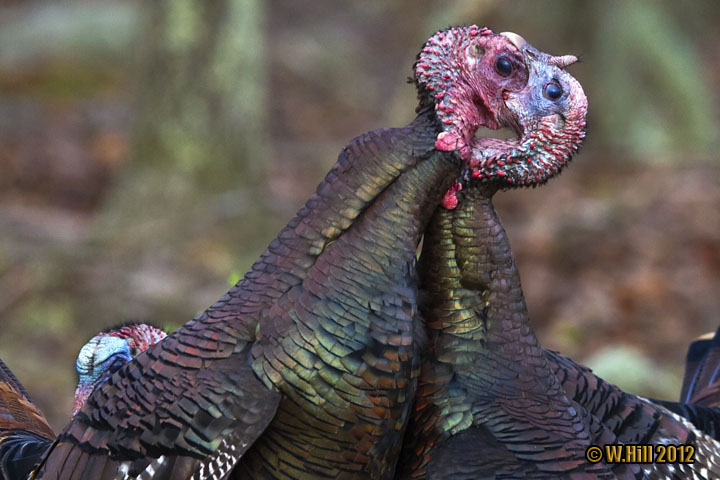
I have been spending most mornings and evenings photographing the Eastern Wild Turkey Mating season. At this point it seems that due to the early warm spell that we had in late winter and early spring, the peak of the strutting and gobbling activity has passed. In fact I have not seen a mature gobbler strutting in the past week, although I have seen jakes (immature gobblers) doing so. I see a flock of jakes each day and these are some of the most combative birds that I have encountered. If a solitary mature gobbler, or pair of gobblers get close to them, they will attack--sometimes in a flying V military type formation. Sometimes they even fall out among themselves. This happened on Thursday morning, and I  filmed and photographed  the longest gobbler fight I can recall seeing.

Jakes Fighting: Canon 40D-28-135mm EF IS ISO 400

 It all began with a lot of cackling and running about and then one jake grabbed another by the head with the tip of his beak.  I frantically got the video camera positioned and began filming until I captured several minutes of the action and then reached for the Canon 7D and the 300mm F2.8, which was on a tripod beside the video camera in the blind. (I took the above photo hand held at one point to get a still photo that established the scene).  

The heads were the main point of contact between the birds, and the area in which they grabbed each other changed from time to time.  In the photo below the one on the left has his upper beak rammed down the throat on the one on the right.

Headlock:  Canon 7D -300mm F2.8 IS L ISO 640 1/500 sec. f2.8

 For a time one bird controlled the other simply by grabbing it with the point of the beak.  This had to be a painful experience.

Controlling With Beak:  Canon 7D -300mm F2.8 IS L ISO 640 1/800 sec. f2.8

 In the photo below there are four birds.  The one in the back to the left and the one in front are looking on, while the two birds in the previous photo are still connected by the tip of the beak hold.  At times they would also enter the fray and in a few cases turkeys would leap in the air, kick their opponent and beat them with their wings.  I captured some of this on video, but got no good still photos.

 "Come On--Take Him Down!:  Canon 7D -300mm F2.8 IS L ISO 640 1/800 sec. f2.8
  
Shortly before the fight ended they walked into an area where the sunlight created a spotlight effect in the forest.  This shows how birds often entwine their necks when fighting.  It reminds one of two snakes twisted together.


 Twisted Together: Canon 7D -300mm F2.8 IS L ISO 640 1/1000 sec. f2.8

In a few more moments one of the birds decided enough was enough, broke away and left at a leisurely pace.  Soon the entire flock began moving slowly to another area and the excitement was over for the morning.

I used ISO 640 as a compromise to get a sufficiently high shutter speed to capture the action, while still having a reasonable noise level in the image.  While ISO 800 is usable with the 7D, I much prefer to stay at 400 or below--although 500 and 640 are not bad. 
Originally published at Pennsylvania Wildlife Photographer by Willard Hill.


Friday, April 6, 2012

Eastern Wild Turkey: Gobbling Season Continues

Mature Gobbler Struts During Peak Of Mating Season: Canon 500mm F4 -ISO 100-1/1000-f4
Camera hunting differs from gun hunting in that season is never closed unless an area is restricted to bar photographers, but yet one still faces the constraints of the natural seasons.  While One can certainly photography turkeys all year around, the fact remains that springtime is the most interesting period to do so as that is when the birds are most active and the gobblers look their best as they strut and gobble during mating season.

It is quite an experience to film or photograph a mature gobbler in full courtship display, especially when they are in a very aggressive mood and gobble frequently.  Some prefer to photograph the birds in meadows, while others prefer the woods, but I like to select an area to place by blind that is at the edge of a meadow with woods to my left and meadow to the right, which gives me the opportunity to try for both types of photo if the birds co-operate.

Mature Gobbler In Woodland: Canon 300mm F2.8- ISO 400-1/320-f2.8
It is especially rewarding when one of the large birds walks extremely close to the blind and parades about.

Mature Gobbler Close Up-Note that ear is visible-Canon 500mm F4-ISO 200-1/1000-f4
Here in southcentral Pennsylvania, gobbling season is now at its' peak.  Birds will still be active when spring gobbler season comes in on the last Saturday of April, but activity will be less than it is now and it will crash on public lands that are subjected to heavy hunting pressure.  Although it is possible to hear gobblers at times throughout the year, most of the gobbling activity will be over by late May or early June.

Originally published at Pennsylvania Wildlife Photographer by Willard Hill.

Friday, March 30, 2012

Eastern Wild Turkey Mating Season: A Contrast In Appearance

With the unseasonably warm weather, the turkey mating season has been well underway for the past few weeks, and even though the last few mornings have been either cold or windy, activity continues to be exceptional. I never cease to be amazed at how the appearance of the mature gobblers and jakes change when they engage in the courtship ritual.  Normally they are a sleek looking bird, with a small and not particularly attractive head.

Jake Pauses To Look For Danger
Jakes Preparing To Roost In Evening
Contrast these photos with those of a similar bird when he is aroused and strutting in full courtship display.

Jake Struts
Even more impressive is the sight of a mature gobbler performing the courtship display, and a morning spent photographing these magnificent birds ranks near the top of things that I like to do,

Mature Gobbler Struts-Note Wings Dragging The Ground

Two Gobblers Strutting
All photos were taken with the Canon 7D and 500mm F4 L lens at f4 aperture at either ISO 200 or 400.

Originally published at Pennsylvania Wildlife Photographer by Willard Hill.

Wednesday, January 11, 2012

Early Winter Wildlife: A Slow Period

This is an especially difficult time to get satisfying wildlife photographs and video as many of the bucks were killed in the past season, and the survivors are very cagey.  The lack of snowfall is another big minus.  Yes I do like the mild temperatures and dread the thought of dealing with snow, but it does open the door for great photo opportunities.

With that being said I was able to capture a portrait of a beautiful young button buck with the 500mm lens on a crisp, sunny morning. 

Button Buck Poses In Early Morning Sun

Turkeys are also seen at times, but they are usually walking or feeding their way across the meadows and seldom give good poses or do anything interesting, except when they fight among themselves. But this morning I saw a turkey fly  into the meadow in front of me, so I got the camera in position in the hopes and more followed, giving me several photo opportunities with the Canon 7D and 500mm lens. Here are two of the best shots.

Eastern Wild Turkey In Flight
Turkey Prepares To Land
 I did get a few frames of the birds landing, but none were sharp enough to use.  The birds were at fairly long range so the photos are heavily cropped, I would have liked to have been closer, but these are the first sharp photos I have taken of turkeys in flight so I am happy with the results overall.

Originally posted at Pennsylvania Wildlife Photographer by Willard Hill.
.