Showing posts with label Skywatch Friday. Show all posts

Thursday, June 26, 2008

Sky Watch Friday: More Pennsylvania Elk Photos


Ronald "Buckwheat" Saffer and I encountered a herd of cow elk with a spike bull last Wednesday evening. It was one of those evenings with a lot of clouds in the sky. There were periods of sunshine, interspersed with times that the sun was behind the clouds. When the sun did shine, there was very dramatic lighting. Since we were busily photographing the elk, I did not want to change lenses, so at one point I took this shot of the sky with the 100-400mm. This photo is cropped to give it a panoramic look as it is actually more appealing in this format.


Taken From Winslow Hill Toward Quehanna Wild Area: Canon 40D-100-400mmF5.6L at 100mm

One seldom gets to photograph elk against such dramatic cloud formations. I have taken some very effective shots of animals later in the evening, when the shot was exposed to make a silhouette of the foreground and the animals against the sky, but this is one of the few times that I have been able to get good detail and exposure in both the animals ands the sky. I used the f13 aperture to get both the foreground and sky as sharp as possible.

Canon 40D-100-400mmF5.6L at 250mm 1/125 sec. F13 ISO 200

The final photo was taken at 1/350 sec. so as to stop the action. It did work in this case, but sometimes even more speed is required for successful action shooting. Notice that the depth of field is not as great in this case so there is not as much detail in the sky!

Canon 40D-100-400mmF5.6L at 300mm 1/350 sec. F8 ISO 200

I have not used the 100-400mm much in the last year, but both Salty and Billie Cromwell reported good results with it on the Canon 30D, so I pressed it back into service, and I must say that I am pleased with the results. It did work well on the Canon 10D which I previously used as long as the image was not cropped a significant amount. It seems to be a different story with the 30D and 40D and stands up well to cropping. Is it as good as the 500mmF4? No, but the 500mm is not nearly as versatile. In this case I could not have been shooting video also, but would have had to have the 500mm on a tripod and been further away to get the same composition. As it were, I could use the video camera on the tripod and carry the 40D with 100-400mm on my chest. My favorite shooting method in this case is to rest the rear of the 40D on an accessory bracket on the back of the XL-H1 camcorder and rest the lens in my left hand which is in turn supported by the top of the camcorder near the front of the body. This combined with the image stabilization gives one excellent potential for sharp images.

For more Sky Watch photos, visit Tom at Wigger's World!

Thursday, June 12, 2008

Sky Watch Friday-A Cold Front Brings Relief

The passing of a cold front on Tuesday evening, brought a welcome relief from the recent heat and high humidity. Wednesday morning was clear and beautiful with an invigorating tang in the air before warming at mid day.

Canon 40-D: 17-40mmF4L

I have sighted a lot of wildlife lately, but have not had another good opportunity to photography fawns. I did see another doe with a fawn in a wooded area, but had no chance to use the camera. I noticed the chipmunk in the photograph below as I was driving a narrow, winding back road. He ran under the log when I stopped, but I got the camera in position, and he soon returned for a good photo op.

Canon 40-D: 100-400mm L at 365 mm-1/125sec. f5.6 ISO 800

The woodchucks have been frequent visitors to the meadow. The first shot is of the mother, while the second is a juvenile. They have grown quite a bit since the post where the entire family was pictured in one shot.

Canon 40-D: 500mmF4 L -1/350 sec. f5.6 ISO 100
Canon 40-D: 500mmF4 L -1/180 sec. f8 ISO 100

I hope to have more encounters with the fawns soon, but they are the ones that set the agenda and all I can do is to be prepared and try to make the best of the situation when it happens again!

For more sky watch photos visit Tom at Wigger's World

Thursday, June 5, 2008

Sky Watch Friday-Wildlife In The Meadow

The weather has been very unsettled lately providing many opportunities for photographing unique cloud formations. I spend most early mornings and late evenings at this time of year at a favorite meadow, which I described in the previous post. I captured these beautiful cumulus clouds as I was leaving the area on last Friday Morning.

Canon 40D: 17-40mmF4L at 17mm 1/750 sec. f8 ISO 100

Late May and early June brings exciting action to the outdoors. The young of many species are born in this time frame. A family of woodchucks made the day on the morning of June 1. I had loaned "Salty" of Country Captures my 100-400mm lens since I seldom used it. He liked it so well that he purchased one recently, so I pressed mine back into service and I am finding that it works much better on the Canon 40D than it did on the 10D. I had found that this lens would not stand up to severe cropping on the 10D while the superb 500mmF4 and the 70-200mm 2.8 would. Salty used the lens on a Canon 30D and it was obvious that this lens performed much better on that camera. I am pleased with the results so far on the 40D. This lens is not as sharp as the 500mmf4, but one misses a lot of opportunities with that lens because of the difficulty of getting it in action unless one is on stand with it mounted on a tripod, waiting for wildlife to appear. The 100-400mm allows one to take the quick shot of a situation that is not going to last.


Canon 40D-100-400mmLF3.5-5.6 1/180sec. f5.6 ISO 400


I am anxiously awaiting the arrival of the first newborn fawns. This is perhaps my favorite doe. She is totally acclimated to me and spends a lot of time feeding near my stand. She is six years old. She had a single fawns for two years, but had a set of twins last year-one a buck and the other a doe. Judging from the size of her distended abdomen I predict that she will have twins again this year, but I may or may not see them. It is common for deer to lose one or all of their fawns due to problems in the birthing process or predation. In this area the most common predators are coyotes and black bears. Does are more likely to lose the fawns at birth following a severe winter as the strain of survival can negatively impact the fawns development. Since it was a mild winter the chances for survival are excellent.

Canon 40D-100-400mmLF3.5-5.6 1/180sec. f5.6 ISO 400

In all likelihood she will give birth in the next few days. This morning I noticed that she did not follow her fawns from last year when they went to the mountain to lie up for the day, but slipped into the brush near a stream. This is a good indication that birthing time is quite near.


I hope to be able to post photographs of the newborn soon, but they do not always co-operate. I have seen fawns within a day of when they were born, but sometimes it is a week or more until they appear. (One can tell birth has occurred by observing the doe closely. If she looks like the doe above one day and appears the next with sunken flanks and a smaller abdomen, one knows the fawns have been born.)

For more Sky Watch photographs visit Tom at Wigger's World

Thursday, May 29, 2008

Sky Watch Friday-Cirrus Clouds


We have had some beautiful cloud formations lately. Even though it was flat mid-day light, I still thought these clouds were worth photographing. These high wispy formations are known as cirrus clouds.
Canon 40-D 17-40mm F4 1/350f8 ISO 100


Canon 40-D 70-200L F2.8 1/60 f8 ISO 100

To view other sky photos visit Tom at Wigger's World. A big thanks to Tom for making this weekly event possible!

Thursday, March 6, 2008

Sky Watch Friday: More MIddle Creek Waterfowl


To understand this series of photographs better, please read the post of Tuesday March 4th, first, as it lays the background for today's series.

Middle Creek Sunrise: Canon 40D 28-135mm

Waterfowl leaving lake to feed: Canon 40D 70-200mmF2.8

Snow Geese circling over feeding area: Canon 40D 300mmF4

Snow Goose Landing: Canon 40-D: 500mmF4

In spite of a mostly overcast sky, there was a colorful sunrise. At sunrise many of the waterfowl left the lake to feed in the surrounding field. For a time we had few good photo opportunities, but finally the sun broke through the overcast for good and we were treated to that bright, yet milky sunlight that often precedes the arrival of a storm front. This type of light is a result of the sunlight being filtered by a high thin clouds although sometime areas of the sky were a beautiful blue.

In late morning we found the geese converging on the corn field shown in the previous post. They came by the thousands, circled over the area, and then swooped in for the landing in the corn, where they fed on what grain that still remained.


Thursday, February 28, 2008

Sky Watch Friday

Another Look At The Moon


Canon 40D: 300mmF4
It seems that the moon in becoming one of my favorite subjects. I arrived at my favorite observation post early last Monday morning and the moon was still shining. I noticed that the trees framed it quite nicely so I took several shots of it and this seemed to be the best one!

Thursday, February 7, 2008

Rainbow In Winter


Canon 40-D: Canon 28-135mm EF
With the weather conditions being more like late March than early February, I was not surprised to see a rainbow after a brief shower on Wednesday evening.

Thursday, January 10, 2008

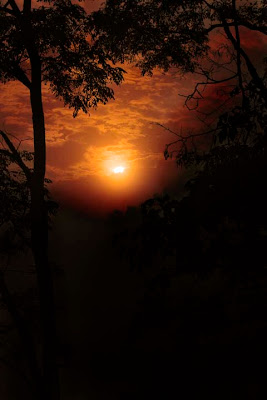
Fulton County Sunrise

While sorting through some pictures from this summer in search of suitable pictures for a DVD jacket I came upon this sunrise photo which was taken on August 26, 2007. The camera was the Canon 10-D with 70-200mm F2.8 L IS at 70mm.


I don't remember exactly how I did it, but I added the fiery color in photoshop. It was sort of drab looking before I did that. Actually it would likely make a decent black and white also.

I hope to soon continue the narrative about the elk, but there has been too much going on lately to do serious writing.