Showing posts with label Shenandoah National Park. Show all posts

Saturday, September 19, 2015

Late Summer Whitetails-Pre-rut Begins

With all the coverage of the changes coming to Winslow Hill, I have not posted anything but elk related material since mid-August.  I like photographing whitetail deer as much or more than I do elk and spend far more time around deer than any other species.  With that being said, most of the bucks in my area are not exceptionally large so I have to travel to find the truly large racks. For many years Shenandoah National Park was my favorite destination for that purpose, but that abruptly ended in 2012 when most of the bucks at Big Meadows were collared and several of the mature bucks vanished.

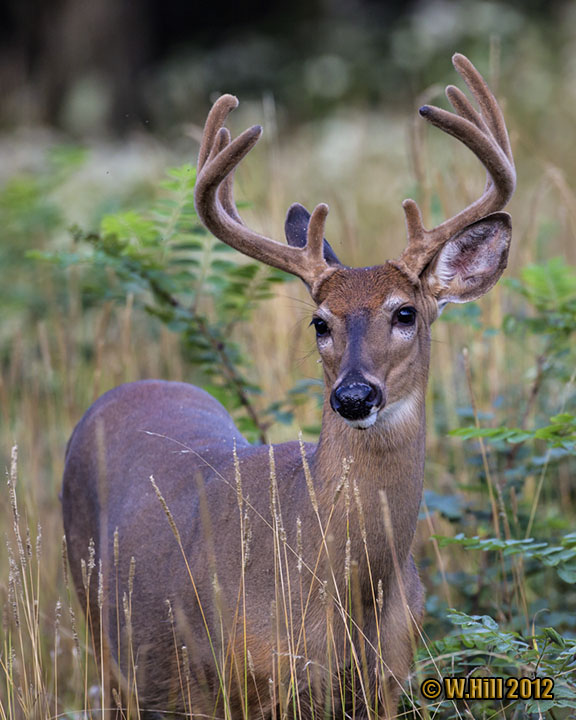
I only took one trip to SNP this summer, which was in late August, just before the velvet was shed.  We saw a few spikes and does, but deer were very scarce.  The trip was made worthwhile; however, by an encounter with a beautiful buck that had thirteen points if you go by the Boone and Crockett 1" rule, or fourteen if you count any protrusion.

Superb 13-Point: Canon 5D MK III-Canon 100-400mm L IS II@349mm-ISO 400-1/400 sec. f 6.3
Even this buck had not escaped the heavy hand of man as he was fitted with a small ear tag, which was easily removed in Photoshop. Yes, I plead quilty-- I have no compunction at all about cloning out an object on wildlife which should never have been there in the first place.

In the old days I would have returned and attempted to photograph him shedding the velvet, but I stayed home this year and the local bucks were difficult to see. I only filmed a small spike that was in the process of shedding his velvet, but one should not pass up an opportunity just because an animal is young and small. Spikes can make large bucks in later years if they survive.  "Once a spike-always a spike" is simply a statement that is not true in many if not most cases.

Yearling Buck Sheds Velvet: Canon 5D MK III-Canon 100-400mm L IS II@ 300mm-ISO 640-1/320 sec. f  5.0
On a beautiful, cool morning earlier this week I photographed an eight-point that had shed his velvet completely.

8-Point Buck: Canon 5D MK III-Canon 100-400mm L IS II@300mm-ISO 1000-1/125 sec. f 5.0
Pre-rut activity is underway and movement patterns are changing.  I filmed this buck with the GH4 making a scrape and horning tress soon after I took the photo above and have filmed one other buck doing this as well.

The pre-rut will intensify through October until the full-blown rut erupts in late October or early November.

Originally published at Pennsylvania Wildlife Photographer by Willard Hill.

Thursday, January 22, 2015

SNP CWD Plan Comment Period Extended-Meeting In Front Royal Tonight


Due to a glitch in communications I was not aware that the period for commenting on Shenandoah National Park's CWD Management Plan had been extended until this morning.  A public meeting will be held this evening  at the Warren County Community Center, 538 Villa Avenue in Front Royal, Va. Read about it in the Shenandoah National Park News release below:

This also extends the time for public comment until January 30, 2015.  The additional public meeting was scheduled and the comment period extended to address concerns by several landowners who own land adjacent to the park about the proposed CWD plan.

Shenandoah National Park Holds Additional Public Meeting and Reopens Comment Period for ChronicWasting Disease Management Plan 


 Date: January 7, 2015 In response to a request from several park neighbors, Shenandoah National Park will hold an additional public meeting on the park's proposed Chronic Wasting Disease (CWD) response plan.The meeting will be held at 7:00 p.m. on Thursday, January 22, 2015, at the Warren County Community Center, 538 Villa Avenue.Dr. Jenny Powers, National Park Service Wildlife Veterinarian and CWD expert, will make a presentation on the history and biology of the disease.Jim Schaberl, Shenandoah National Park Chief of Natural and Cultural Resources, will present the park's proposed plan.Park Superintendent Jim Northup will be available to answer questions. Experts from the Virginia Department of Game and Inland Fisheries will also be available to answer questions on CWD actions outside the park. Following the meeting, the park will reopen the comment period for eight days.

Shenandoah National Park management is proposing to amend the approved 2013Chronic Wasting Disease Detection/Assessment Plan, Shenandoah National Park to include response actions necessary to address chronic wasting disease (CWD) within five miles of or within the park. Although CWD has not been detected in the park, it has been documented approximately 12 miles from the park's northern boundary. The spread of the disease into the park appears imminent, and park staff has determined that a plan for managing the disease is needed. CWD is a serious, non-native disease which threatens deer populations, related natural resources, and visitor experiences at Shenandoah National Park. The proposed plan amendment calls for the lethal removal of deer within specific developed areas of Shenandoah National Park to reduce the likelihood of CWD establishment and decrease the disease's progression within the park.

The draft amendment/EA for this project has been prepared in compliance with the National Environmental Policy Act (NEPA). A series of public meetings on this topic were held in November, and the public was given an opportunity to comment during a 30-day comment period which ended on December 10, 2014.With the addition of another meeting the public will now be able to comment again on the draft plan from January 22 until January 30, 2015.The draft plan is available for review and comment online at http:parkplanning.nps.gov/shencwd.Comments may also be sent to: Superintendent, Shenandoah National Park, Attn: CWD Response Amendment/EA, 3655 US Highway, 211 East, Luray, VA 22835.

For more information about Chronic Wasting Disease, please visit  http:wwww.nps.gov/shen/naturescience/cwd.htm.


Wednesday, November 26, 2014

Shenandoah National Park -The Assault On The Whitetail Continues


When I first heard of the CWD study at Shenandoah National Park back in 2012, the first thought that entered my mind was that this was just the preliminary step toward a drastic herd reduction in the park. As it turns out it seems my worst fears are going to be more than realized, but for some time park officials seemed to  divert attention away from what they really intended to do and to downplay the severity of it.

In a News Release dated December 5, 2013  SNP officials announced that their  staff had completed a planning process for a Chronic Wasting Disease (CWD) Detection and Assessment Plan.  This followed the park  receiving a Finding of No Significant Impact (FONSI) decision. The purpose of the CWD plan at that point was to establish a framework in which SNP officials could determine whether CWD was present in the deer population within the park and if was found to determine the number of infected animals and their location in the park.  This would all come together in a   management plan to deal with CWD in the park and to co-operate with the Virginia Department of Game and Inland Fisheries in detecting the disease, etc.

The news release went on to list four options for the detection and/or assessment of CWD within the park.,
 1. Opportunistic sampling (mostly testing road-killed deer)
 2. Targeted surveillance(looking for and sampling sick/emaciated deer)
 3. Enhanced live-testing (live-sampling healthy appearing)
  4. Lethal removal

At this point the lethal removal option appeared to be downplayed as the third paragraph of the news letter states, "Sampling will occur in areas of the park within 30 miles of a known CWD case. If needed to achieve a statistically valid sample size for the detection or assessment of CWD, the park may lethally sample up to 150 deer over a three year period for detection or approximately 70 over a two year period to determine prevalence and distribution. The park will only lethally remove deer for sample after exhausting all other non-lethal sampling methods (e.g., enhanced opportunistic (mostly road-kill), enhanced live-testing, and hunter-harvest/road-kill testing by the VDGIF within the surveillance area).The park will primarily sample and remove deer near the closest developed areas (e.g. Dickey Ridge, Mathews Arm, Skyland,and Big Meadows). Deer will be sampled from developed areas because these areas have higher deer densities and are, therefore, at greater risk of CWD introduction and spread .Lethal removal sampling would occur during periods of low visitation."

Pay special attention to this sentence from the paragraph above, "The park will only lethally remove deer for sample after exhausting all other non-lethal sampling methods".  If someone read this in a positive frame of mind, it tended to relieve their concerns as it gave the impression that lethal removal was extremely unlikely to happen or be minor in nature if it did,  but if we jump forward to late 2014 and read the SNP  CHRONIC WASTING DISEASE DETECTION AND ASSESSMENT PLAN AMENDMENT of October 2014 it becomes clear that they did employ lethal sampling methods on park deer or at least they certainly seem to say that they did.

If one goes to page 21 and looks  under the heading, "Impacts of plan with addition of proposed response actions" they state, "As previously analyzed (NPS 2012a), the current detection and assessment actions have some adverse impacts on visitor use and experience when visitors are unable to access certain areas of the park because area closures are required for safety reasons during lethal removal for sampling". They go on to point out on page 22 that "The addition of the proposed response actions may require additional area closures to conduct density reductions but these are not expected to noticeably change the level of impact on visitors beyond what was previously analyzed for detection and assessment actions, alone." Even if one reads the document quite closely there are times that you are not sure if they are writing about something that has already happened or if they are stating that something that is to happen in the future will result in little difference in visitor experience, over something that has already been planned for the future, but not yet implemented--it is that vague. .

The conclusion on page 23 does a good job of summing it up; however, and seems to leave little doubt that that they have already removed deer by lethal means when beginning with the second sentence they say "The adverse impacts of area closures for density reductions would not be noticeably different than what visitors currently experience when areas are closed for lethal removals for detection and assessment. Closures for density reductions may be somewhat longer or at different times of the year, but the overall adverse impacts would not change from existing, either individually or cumulatively".

Concerning negative impacts, the conclusion states, "The main difference as a result of adding response actions is decreased opportunities for visitors to regularly view and photograph deer in favored locations such as Big Meadows. Deer would still be present but in smaller numbers, on a less regular basis, and may be less tolerant of human presence. This would probably reduce the enjoyment of visitors who come to the park specifically to see deer in Big Meadows and other favorite viewing areas.  It goes on to justify the herd reductions by pointing out that, "This would not reduce the overall visitor experience of the park because deer densities in these areas would be more similar to natural deer densities that occur throughout the park, which is in keeping with the natural conditions and experience that the park was established to conserve and promote."

The conclusion sections ends with, " Public outreach and information may promote greater understanding of the need for the response actions, alleviating some of the adverse impacts".

 Thoughts  From Blog Readers

 Wildlife biologist, Kirk, commented on my last post, . " If your interest is in the conservation of the whitetail herd, let's agree that the current density of WT's on NPS property from Shenandoah to Gettysburg is somewhere between 20 and 50 TIMES the threshold for "high likelihood" of transfer of CWD as it's practiced in much tougher, sparse terrain out west. Not 20%. 2000%! And that number is likely pretty low.
I'm not arguing this as a hunter (Lord knows that hunting on NPS ground is a debacle at best), but as an actual wildlife biologist. Photography is important. Visitors (and fee payers) are important. But there's absolutely nothing in anyone's action plan to reasonably react to a 50% or 80% herd die off."

(I assume from this that he is meaning that  a 50% or 80% mortality rate from CWD is possible  rather than the lower rates usually reported  in states like Colorado are because of the much higher deer density in SNP.)

Kirk goes on to say, "There's no "non harsh" way through this, is what I'm proposing. Thanks for bringing up the issue, I hadn't heard about this, and I'm well versed in NPS' typical aversion to lethal management of anything, even exotic 30 foot long pythons."

Kirk  also made a follow-up comment-" Also keep in mind that all of these actions occur in context of multiple, often competing, management plans for the NPS units. NPS has been burned badly in court numerous times for not aggressively acting to take precautions to preserve designated habitats and species from "forsseable" threats. Whitetails are at a high density on NPS lands, we all agree on that, and guess what, they don't eat the invasive plants."

A Virginia wildlife photographer, Larry W. Brown, who is very familiar with SNP said, "To state that this is a bad situation for the SNP whitetails would be a major understatement. The ignorance of the SNP wildlife management officials to continue on with these herd reduction plans makes no sense whatsoever. There have been 7 known cases of CWD in that county since 2009, so if CWD was as bad as they make it out to be, wouldn't the deer populations in that area have already suffered? And have already spread into SNP? Since 2002, over 7,600 deer in Virginia have been tested for CWD. The Va DGIF has diagnosed ONLY 7 positive cases of CWD in Virginia. The statistics speak for themselves.

Another Virginia wildlife photographer, Jim Fields, who I first met on A Sunday summer  morning in Big Meadows back in the film photography day,s  chimed in with a very relevant comment, " SNP is using CWD as a scare tactic to convince the unknowing public that an 80% cull is needed in Big meadows. If CWD was a valid concern the parks efforts would focused at the North Entrance of the Park nearer to the CWD positive specimens. As Larry mentioned Virginia does not have mass numbers of deer killing over from CWD. There has only been 7 CWD positive deer found to date and none of these were in SNP.

As you know in the Amended plan there is no mention of herd management with consideration given to keeping genetically strong specimens or proper buck to doe ratios to produce quality bucks, does, and fawns for future generations. This is purely a kill plan to eliminate mass deer numbers specifically in Big Meadows.

Additionally If you visit SNP you will find no information regarding this subject displayed for the public at any of the park facilities. I purposely went in the Byrd visitor center yesterday I was handed a copy of the press release from behind the counter only after I inquired about the deer reduction in BM. There was no copies of the amended plan available at the center."

Another wildlife enthusiast,  Kaleen, said, " The Shenandoah National Park situation is heartbreaking. I have been going to the park for over 40 years and have loved and photographed the deer and other animals all that time. The park's plan is insane and illogical. There is not enough evidence to support such drastic action, and the only way to completely prevent this disease in the future would be to eliminate all the deer, which the current park plan would almost do. The park has ruined wildlife photography, to say nothing of the suffering, evident in photos, of the collared deer. The poor deer do not stand a chance, and this planned nighttime shooting will lead to poor shots and injured and suffering deer. The whole plan is senseless and will do nothing to prevent the disease from ever reaching the park, which is not likely anyway. The park officials seem to have lost their minds. They should take a lesson from Pennsylvania's game management."

My Thoughts

When we sift to the bottom of all of this it boils down to the fact that they are willing to sacrifice 80% of the deer herd at the popular whitetail areas such as Big Meadows because, according to Larry Brown , 7 deer have tested positive for CWD in the State of Virginia and this is confirmed by The Virginia Department of Game and Inland Fisheries Website.

Remember they intend to Shoot 80% of the Big Meadows herd because of  SEVEN (7) positive deer in the entire state of Virginia, although it does appear that they need to find a positive deer within the 5 mile trigger distance from the park or within the park itself to begin the 80% reduction. According to a chart on page 8 this means the removal of 130-150 deer from the Big Meadows area to match the populations density of surrounding areas, yet  already  reports are surfacing of experienced outdoors people seeing only a few deer in the Big Meadows Area. Does this mean that a substantial number of deer have already been removed from the Big Meadows area to provide the samples needed for lethal CWD testing if enough specimens were not available from non-lethal methods?

Of course the fear is that CWD will spread and become established resulting in a permanent herd reduction if nothing is done, but even the most optimistic official in my experience will not contend that CWD response plans as implemented by any conservation or federal agency has any chance of stopping the disease--only in slowing the spread of it. 

Remember-To slow the spread of the disease down they plan to shoot up to 80% or the herd to prevent a loss that in a worst case scenario MAY reach 80% of the herd, but would more likely top around 30% and this is assuming that the disease becomes widely established in the park, which is by no means a given.

It is always easy to criticize, but much harder to be responsible for a plan of action, so it is fair to ask what would you do if you were in charge of the situation?

 If I were responsible for the management of the SNP whitetail herd I would manage the herd much as it was before the inception of the CWD study of 2012.  Only visibly sick or injured animals would be removed from the herd and there would be no preemptive shooting.  Expenditure of funds and efforts would be geared toward finding a cure for the disease if possible. It may be that this is something like the gypsy moth was with the oak forests and it will run its' course regardless of efforts applied to stopping it.

As it stands,  The SNP plan is currently being implemented and future amendments will likely meet with approval.  At this writing it appears that the outstanding whitetail viewing and photography  at SNP are over for my lifetime and perhaps for all time although it is to be hoped that at some point in the future responsible people will shake their head at the way war was declared on the whitetail deer in the name of saving them from CWD.

A special  thanks to those who submitted comments  on the November 12th post "Herd Reduction Looms For Shenandoah National Park Whitetails, which are featured in today's post.

Originally Published at Pennsylvania Wildlife Photographer by Willard Hill.


Wednesday, November 12, 2014

Herd Reduction Looms For Shenandoah National Park Whitetails


Future Uncertain For Whitetail Deer
It seems there is no good news these days if ones' primary interest is big game photography--especially whitetail deer photography.  Here in Pennsylvania there have been several cases of CWD and three DMAs (Disease Managment Areas) have been established.    So far the Pennsylvania Game Commission has been fairly conservative in dealing with the disease. On the other hand,  The National Park Service is planning to launch a severe response to the disease once  certain triggering thresholds are met.

We first reported on this in the October 26, 2012 post: "Shenandoah Whitetails Under Assault"  At that time the Park had fitted  a large number of deer with ear tags and/or radio collars and were conducting a whitetail deer study geared to charting deer movements.  In conjunction with this a certain number of deer were to be live tested for CWD. Almost overnight they destroyed the world class whitetail photography at Big Meadows which until that time was one of the best areas to observe and photograph whitetail deer in the United States. 

Mature Buck at SNP 2011
 Last week  fellow retired PGC employee Billie Cromwell traveled to SNP to photograph the deer and returned home after two discouraging days.  He called me to ask if I had been there and advised me to cancel any plans I had to visit the park this fall. I had already decided to avoid the park this year due to my disappointing summer trip this year so this meant no change in plans, but it did re-in-force my sense of discouragement about the situation at the Park.  Billie reported that he saw only a handful of deer in the Big Meadows Area.  Places where they were once seen in plenty now were either empty or there was only a deer or two.  He did report seeing a buck or two that was collared last year, but now were wearing none. Soon after talking to Billie, well known Virginia wildlife photographer, Larry W. Brown, contacted me to tell me that the assault on the whitetails of Shenandoah was not over.

Following the links that he sent me, I found that on November 10, the Park released its' CWD Response Plan Amendment/Environmental Assessment plan , which amends the 2013 CWD Detection and Assessment Plan.  To read about CWD and an overview of the  amended plan click Here.http://www.nps.gov/shen/naturescience/cwd.htm

To read the plan in its' entirety or to comment-Click Here: http://parkplanning.nps.gov/document.cfm?parkID=274&projectID=32501&documentID=62248

While the original 2013 plan allows lethal sampling of deer to detect CWD, the proposed amendment allows deer population reduction by lethal means in front country areas of the park to manage the disease.  This would attempt to bring the herd at areas such as Big Meadows in line with  deer numbers in back country areas of the park and in areas outside the park in an attempt to minimize disease transmission.

Big Meadows is listed as the area in the park with the highest deer density/square mile.  Under this amendment 77-81% of the deer would be removed to equal the density of surrounding areas.

If the proposed plan is approved, it will be implemented when two or more positive CWD cases are found within 5 miles of the park boundary or if detected inside the park.  According to the news release this could happen fairly soon (1-3) years or it could be many years away, but it is expected to happen sooner or later.

Also of importance to photographers is that there will be no protection for the mature bucks and all adult deer will be targeted equally.  When it comes to killing deer for CWD testing, the bucks will receive priority in targeting as bucks 2 years of age or older are more likely to have CWD and as they roam over a wider range are supposedly more likely to spread the disease.

Mature Bucks To Be Targeted
Herd reduction will most likely be done at night, from November-March. Specific nighttime area closures may be necessary from November - March in the Central District of the Park so that deer way be shot at areas such as Skyland and Big Meadows.

Public comments may be made either online or by mail.
Comments should be posted online at
http://parkplanning.nps.gov/shencwd
Or, send to: Superintendent, Shenandoah National Park, Attn: CWD Response Amendment/EA, 3655 US Highway, 211 East, Luray, VA 22835. 


Public Meetings
Public meetings are scheduled on November 17 (Crozet Public Library, 2020 Library Avenue, Crozet, VA), November 18 (Elkton Community Center, 20593 Blue and Gold Dr, Elkton, VA). All meetings start at 7:00 PM. 


Look for more commentary on this and the situation in the Pennsylvania Elk Range within the near future.  

Originally published at Pennsylvania Wildlife Photographer by Willard Hill.


Sunday, August 10, 2014

Shenandoah National Park Whitetails: The Dream--The Reality

Whitetail photography and deer watching in the Big Meadows Area of Shenandoah National park was destroyed in 2012 by the implementation of a whitetail deer study which resulted in the mature bucks at Big Meadows being fitted with radio collars or ear tags and seems to have resulted in a significant reduction in the whitetail population. I had not been to SNP since November of that year after I left in disgust on the first morning of what was scheduled to be a multi-day trip.

After  almost two years of avoiding the park, I decided to check in on the whitetail situation at SNP once again.  As a result, on a late July morning I left home in the wee hours of the morning so I would arrive in the central district of the park at dawn. As I traveled down I-81 my thoughts wandered back through the years and I recalled the countless times I made this trip with visions of herds of deer and large rack bucks grazing in the beautiful summer morning running through my head and how that  more often than not the trip met or exceeded my expectations.  I knew things would be different this year, but it was nice to pretend that the events of the last few years had not taken place.  If one had any doubts as to whether the situation was not as bad as expected, it did not take long to dispel them.  I saw not one deer by the roadside as I traveled  Skyline Drive from Thornton Gap to Big Meadows as dawn was breaking.   I arrived at Big Meadows to be greeted by a beautiful but unusual sunrise.

Big Meadows Sunrise
Only a handful of deer were scattered about in the meadow, none of which were bucks, so I made the loop to below Milam Gap.  An eight-point was grazing along the road before the Milam Gap parking lot, and it was fitted with a collar that had worn most of the hair from the neck.

Collared Buck At Milam Gap
After taking a few photographs, I returned to the meadow where a small herd of deer was now visible in the distance. Three were respectable bucks, but all were wearing collars.  I decided to work these animals and walked into the meadow and took position in a spot it seemed likely they would pass through.  In a few minutes the herd arrived minus one of the bucks, which evidently split off to go elsewhere.  Two bucks were in the lead and for a few moments it seemed like the old days as one could see the tips of the velvet covered antlers bobbing above the bushes and grasses. One almost expected a buck such as this to appear and he did, but there was one big problem.

The Dream
The photograph below shows what he really looks like. 

Harsh Reality
Photographers will argue the ethics of such matters, but it is easy to remove collars and ear tags in Photoshop or similar programs if the collars are relatively small and the neck hair is undamaged, but this is not the case with the Shenandoah deer where the collars are huge in proportion to the animal and the hair is usually damaged.  In this situation there was not enough hair available to clone over the collar so a neck was used from another buck in  photographed in 2011, which was standing in a somewhat similar position.  It would be unethical to enhance the damage to a deer's neck, but  I see nothing wrong with  removing something that should not be there in the first place. However, at this point in life, I have little interest in doing so as it is difficult and one still is left with the unpleasant memory of how the situation actually was.

The second buck was worse yet, as most of the hair was missing from the neck.

Collared Buck With Significant Hair Loss
A mature doe was feeding with the bucks and she too was wearing a collar.

Mature Doe
Each of the deer that was collared also had a small tag in the right ear, which is visible in the last two pictures.

It seems at this point that the battle is lost with little hope for the future.  The National Park Service has been granted a finding of FONSI (Finding Of No Significant Impact), which as I understand it, gives them the go ahead to implement their plans.  http://www.nps.gov/shen/parknews/shenandoah-national-park-completes-cwd-detection-and-assessment-plan.htm .  I found a good definition of "FONSI" on a Department of Energy Page: "Findings of No Significant Impact are public documents issued by a Federal agency briefly presenting the reasons why an action for which the agency has prepared an environmental assessment will not have a significant effect on the human environment and, therefore, will not require preparation of an environmental impact statement. http://energy.gov/nepa/findings-no-significant-impact-fonsi  They are perhaps right that the collars, ear tags, neck injury, and herd reductions means nothing to the average visitor to SNP,  but to the whitetail deer and those that are interested in them, the impact is significant and severe.

Originally published at Pennsylvania Wildlife Photographer by Willard Hill.

Tuesday, January 14, 2014

HSUS Investigates Shenandoah Nation Park Whitetail Collars-Calls For Photos

The Humane Society of the United States (HSUS) is requesting that photographers send them recent photos of deer showing damage from the collars that are being used in the CWD study at SNP.  This will be somewhat difficult as most whitetail photographers do not travel to the park in winter and those that did are less inclined to do so since the study began, but I assume that photos taken during the past fall are wanted.

First a bit of history for first time readers and a re-fresher for  those who have been following the problem. In late August or early September of 2012, we learned about the CWD study at Shenandoah National Park from well known Virginia wildlife photographer, Larry W. Brown.  As a result of the study, most of the mature whitetail bucks in the Big Meadows area were fitted with radio collars.  This was initially discussed in the October 26, 2012 post, " Shenandoah Whitetails Under Assault" and followed up by Shenandoah Whitetails Under Assault Part II", on October 30, 2012. This post featured photos of  several collared bucks, which were taken by retired PGC Maintenance Supervisor Billie G. Cromwell. For those who want more background, I recommend that you read past posts and follow the links to material by Larry W. Brown and others.

Mature Buck With Collar Big Meadows Campground: 2012 Photo by Billie G. Cromwell
Fast forward to this year. After a mid-November trip to SNP, Billie Cromwell shared some of his photos that illustrated just how these collars negatively impact the deer.  This was discussed in the post of November 21, 2013, "Whitetail Photography at Shenandoah National Park-Destroyed For Now"  This post featured  the above photo and several of the buck in 2013, which showed  damage to the neck from the collar.

H2 in 2013: Photo Courtesy of Billie G. Cromwell
As a result of reading the series of posts, fellow photographer, Dan Gomola contacted the Humane Society of the United States (HSUS) seeking a remedy to the situation. On December 5, 2013 Dan received a reply to his inquiry from Laura J. Simon a Wildlife Ecologist with the Humane Society of the United States (HSUS) thanking him for alerting the HSUS to the situation and promising to look into the matter.

Dan received a report from Ms.Simon on January 10, 2014, which is posted below.

Subject: RE: Shenandoah National Park deer

Hi Dan,

Sorry not to get back to you sooner on this situation!
On behalf of HSUS, I lodged a written complaint with the SNP
Superintendant's office about the deer being harmed by problematic
radio-collars. I spoke today to Jim Schaberl, who is the Chief of Natural
and Cultural Resources -- and the person overseeing the radio-telemetry
study.

He said that some of the deer already had their radio collars fixed in
November and early December, but he also asked me to give him a list of all
problematic collars reported so he could check up on them. I gave him H-2,
F-2, V-7, C-7 and Y-7 (please let me know if there are any more). He thought
H-2 was from the Fall of 2012 and assured me it had been addressed
immediately at that time.

Mr. Schaberl also said that they were disappointed in the collars, that this
design had worked well for mule deer in a prior study done with the US
Geologic Survey, and based on that recommendation the NPS had ordered them
for the SNP study. He said the collars had performed well the first year,
but now some were turning out to be problematic --- they expand, but it
seems the area where they expand is not covered well, there's nothing
underneath, and that is what creates the rubbing and soring problems.
Overall, Mr. Schaberl seemed genuinely concerned about the problems caused
by these collars and anxious to fix them.

What would help is if you could post to the PA Photographers website, and
ask people to please send us and the SNP any recent photos ---- and of the
ones that have already been posted, it would be good to know the dates. It
would also be important to find out if these 5 deer are the only ones seen
with ill-fitting collars: H-2, F-2, V-7, C-7 and Y-7.

Thank you again for flagging this situation -- I will give you another update early next week.

Cheers,
Laura J. Simon
Wildlife Ecologist
Humane Society of the United States (HSUS)
lsimon@humanesociety.org

I assume that photos are to be e-mailed to the humane society at the above address .

Shenandoah National Park's contact information as listed on their website is shown below, but upon opening the e-mail link I see no option to attach photos.

By Mail
Shenandoah National Park
3655 Hwy 211 East
Luray, VA 22835

 By E-mail
Shenandoah National Park

Originally published at Pennsylvania Wildlife Photographer by Willard Hill


Friday, November 29, 2013

More Thoughts About SNP Whitetail Study

Today I would like to thank those who made comments on the blog and on Facebook about the last blog post", "Whitetail Photography at Shenandoah National Park -Destroyed For Now".

Most seemed to agree that the collars are unsightly and are likely to cause the animals a lot of distress, while one reader wants to know if the condition of the animal was reported to SNP officials.

Buck Was Standing Near Visitor Center When Photographed by Billie G. Cromwell

My Response: I spoke with Billie Cromwell who took the photographs and he said he felt no need to report this as the animal was in the lawn right beside the visitor center and was easily visible to maintenance workers and rangers.  As much time as this buck spends between there and the Big Meadows campground makes it extremely unlikely that officials are not  aware of the situation.

Fellow wildlife photographer, Dan Gomola raised the question:"Is there a any way people could band together against animal cruelty of these herds".

My Response:  I have no good answer to this question.  All I know to do is contribute what little I can by trying to draw awareness to the problem.  One should also write letters to officials and attend public meetings.  It would be nice if a large organization with a lot of political clout would take this up but it never seems to happen.  As it is, it seems that the National Park Service has its' way regardless of public input.

Bill, who is an avid hunter and photographer, said, "Those appear to be the most intrusive tacking devices I've ever seen. Monitoring animals for study is fine I suppose but do it in a way that isn't a burden on the animal. With the technology available today those are a little more than over-the-top and ridiculous."

My Response: I agree completely.


Over-The-Top and Ridiculous Collar
Alyssa Johnson who is involved with big game management (as a student in New York State) wrote, " I feel like there must be more to this story than we, and possibly you know. I feel for the animal, of course, because I'm human. But, perhaps there would be more damage done than good to try and remedy this defunct collar. Unfortunately, many people seem to suggest "with today's technology... _________" fill in the blank. Why can't there be a smaller collar, something less obtrusive, microchip, nothing at all, etc. I would like to believe, as someone who is involved with the big game management in my state, that the managers in charge WOULD utilize something less obtrusive, if it was available. I just attended the 2013 TWS National Conference, and was able to handle and examine all kinds of remote-monitoring equipment at the trade show. You lose battery life, distance of signal transmission, type of transmission, and amount of stored data when you make the device smaller. The severity and scope of CWD, for example, is so large and potentially dangerous to our deer herds, that these measures of using hardcore collars, with big packs on them, is so necessary. Without this monitoring, "we" wouldn't be able to manage the deer herds for hunters, photographers, and other wildlife enthusiasts. I'm glad I got to see this pictures, thanks for sharing."

My Response: I will approach the issue by first discussing the Pennsylvania elk herd which I am quite familiar with.  I do not like to see collars on these animals either.  It seems possible that some elk have had problems because of wearing collars, but I have never personally seen an elk's neck severely damaged by a collar.  At one time many of the elk were fitted with brown collars with large yellow side plates attached on which the number of the animal was displayed.  This is shown in the photo of bull 2D below.

Bull 2D-Old Style Collar
This type of collar really became a problem once Pennsylvania elk  became hunted animals again in 2001, as the bright yellow collar made the animal stand out to hunters.  As a result the PGC discontinued their use, but  they did not remove the collars from elk already fitted with them.  From a certain point going forward elk were fitted with brown radio collars. These collars are not numbered like the yellow ones.  The PGC gave up the ability to easily identify individual animals by visual means and must now rely on radio tracking-GPS equipment to do so. I do not like to see these collars on elk any more than I like to see them on deer, but at least they are not causing problems for the animal in most cases.

Brown Collar Currently Used by PGC
In comparing the use of collars on elk and deer one must realize that a deer is a much smaller animal and as such has less space to fit a collar.  This may be part of the problem but it is not all of it. If one looks at the old elk collars closely the numbered panels were not larger than the collar band, but the number panels on the deer collars extend well beyond the collar band.

Numbered Tag Is Larger Than Collar
In addition they appear to be made of a hard material.  It seems likely that this is at least partially responsible for the damage.  Also the brown part of the collar is broken in the photo above, which would contribute to the chafing on this particular animal.  I suspect that these collars were designed so that animals could be visually  identified from a distance without relying entirely on radio transmitters, but if this is the case, does the supposed benefit of this outweigh the damage done to the animal?  Speaking off the record, a  wildlife professional employed by a state conservation agency, said that it could be as simple as the NPS already having that type of collar on hands and using them without giving the matter further thought.

At this point I would like to take a closer look at two portions of Ms. Johnson's comments and respond to them.

Ms Johnson, " I would like to believe, as someone who is involved with the big game management in my state, that the managers in charge WOULD utilize something less ,if it was available."

My response: " I would like to think that too, but unfortunately after working most of my adult life for a state conservation agency,  I wouldn't put too much stock in this. What is proposed and implemented  can be mind boggling at times, in spite of the competence and good intentions of most agency personnel.

Ms Johnson, "The severity and scope of CWD, for example, is so large and potentially dangerous to our deer herds, that these measures of using hardcore collars, with big packs on them, is so necessary. Without this monitoring, "we" wouldn't be able to manage the deer herds for hunters, photographers, and other wildlife enthusiasts."

My response:  I am aware of the statistics on the severity and scope of CWD, but it is not in the least bit clear to me how that measures such as this or drastic herd reduction are going to save the day.  I may live to see the day that I regret this statement, but at this point I think that conservation agency and NPS reaction to the disease has the potential to have a far worse impact on the herd than the disease itself.

In closing, I will mention that I still list a blog or two in my side bar that are no longer updated on a regular basis.  One of these is Larry Thorngren's . "The Wild Photographer".   His last post about radio collars was "Abused Radio-Collared Bison-Yellowstone National Park" on Nov. 6, 2011.  If you are interested in reading more about this type of thing, it may be worth your while to browse through his older posts.

Also check the comments section of this post to read more input from Larry W. Brown and follow the links to see photos of deer in winter that show severe hair loss from the collars.

Originally published at Pennsylvania Wildlife Photographer by Willard Hill.

Thursday, November 21, 2013

Whitetail Photography at Shenandoah National Park-Destroyed For Now!

"Old Rutter Before He Became H 2" in 2012: Canon 7D-300mm f2.8 L IS-ISO 400-1/1600sec f 5.0
Ever since my first visit during the autumn of 1998 I have traveled to Shenandoah National Park in Virginia to observe and photograph the whitetail deer especially during summer and autumn.  As time passed I went more and more often and felt reasonably safe in assuming that regardless of what befell whitetail deer in all of my other favorite spots that the deer of Shenandoah would be there.  I must confess that having worked for the Pennsylvania Game Commission most of my adult life, and therefore being very aware of deer management issues, that a bit of concern did exist in the back of my mind that the National Park Service could also fall victim to the malaise that has effected so many agencies and pursue herd reduction strategies to an unacceptable extent.  This concern was further heightened by the increasing prevalence of  CWD (Chronic Wasting Disease), nevertheless I was shocked when the NPS, suddenly and without warning to the public, collared and/or ear tagged most of the bucks and many of the does at the prime whitetail spots such as Big Meadows and Skyland.  The collaring was an integral part of a CWD and mature whitetail buck movement study.   Public meetings were also held to determine if herd reduction would take place at the spots of major deer concentration within the park either immediately or when CWD was detected  within a certain distance of the park.  Much of this subject has been covered here before, but I will remind readers that well known Virginia wildlife photographers Larry W. Brown and Jim Fields have done an excellent job of bringing this matter to our attention and keeping us updated on it.  For those who have not read it yet I would recommend that they read CWD The Truth by Numbers  by Larry W. Brown.  This well researched article contains a wealth of information on the subject.

The buck shown in today's first photo was a large mature buck that was a favorite with the whitetail photographers at Big Meadows.  Many feared he was missing when he was not seen for a time after the collaring was done, but he was eventually photographed with  a large collar numbered H2.  I only went to SNP once during the rut of 2012 and was so disgusted that I left after only 1/2 day there.  Well known Pennsylvania photographer Billie G. Cromwell did stay for some time and was able to photograph the buck after he was collared.

"Old Rutter" 2012: Photo Courtesy of Billie G. Cromwell
I did intend to make a few day trips to the park this year to personally check the situation out, but after reading reports from Larry W. Brown that the whitetail photography was terrible at Big Meadows I did not go.  With advancing age I find that the 300+ mile round trips are not  as appealing as they used to be, especially when there is not great likelihood of getting exceptional whitetail photos.  Billie Cromwell did spend a few days in SNP last week and was gracious enough to share a few of his photos with us.  He did photograph "Old Rutter".  This once magnificent animal was now suffering from the effects of advancing age with his rack declining in size.  It is possible that the marked decline in rack size was triggered by the trauma of being tranquilized and fitted with radio collar, but as mentioned he does seem to be an old animal.

"Old Rutter" 2013: Photo Courtesy of Billie G. Cromwell

"Old Rutter" 2013: Photo Courtesy of Billie G. Cromwell
This is not the worst part of the story; however.  Many have pointed out that these collars do not fit the animals well and may cause significant hair loss and skin damage. Such is the case in this situation.  I cropped the photos above severely so that the problem areas are easier to analyze and they are shown below.  These photos were taken with a 5D MK III and 300mm f 2.8 lens, but the animal was too far away to get fine detail and sharpness at this degree of enlargement. Note the collar is out of place and in front of the ear on one side, while the hair is missing over a wide area under the collar and the skin appears to be damaged with at least some sores present.

"Old Rutter" 2013: Photo Courtesy of Billie G. Cromwell

"Old Rutter" 2013: Photo Courtesy of Billie G. Cromwell
It amazes me that is legal and acceptable for the NPS to inflict this kind of damage and distress on an animal, yet had Billie walked close enough to the buck to get detailed close-ups of the damaged area it is likely, had he been observed doing so by enforcement personnel, that we would have been warned to not approach so closely as it could cause the animal undue stress and it is even possible he would be arrested.

Billie reports that there were a 4-5 does using the meadow on a fairly regular basis and he saw a few small bucks in the woods around and going to the campground.  The situation was so bad that it did not even seem like Big Meadows.  He did encounter one buck in the woods along the drive south of Big Meadows that did not have a collar and give him a photo opportunity.

Deformed 13 Point: Photo Courtesy of Billie G. Cromwell
Whitetail viewing and photography should recover in time if the herd is not reduced, but considering the numbers of whitetails seen this fall, many are wondering if the herd reduction has not already secretly taken place.  There are very few things that can impact the visibility of park deer.  One and would be a lack of food on top of the mountain, but in years with a poor mast crop, deer are usually concentrated around the open areas such as Big Meadows and so sightings should be higher.  A heavy mast crop could keep sightings in the meadow down, but they should be seen in plenty elsewhere along the drive. As I have not been there this fall, I do not know what the mast crop is like, although it is very poor in our area. Whatever the case one cannot recommend that a serious whitetail photographer visit SNP at this time.

Again I wish to extend a special thanks to Billie Cromwell for most of today's photos and to Larry W. Brown for this efforts in educating the public as to the truth about CWD and the situation at SNP.

Originally published at Pennsylvania Wildlife Photographer by Willard C. Hill.


Tuesday, March 5, 2013

Shenandoah Whitetails Under Assault: Public Meetings Announced

SNP Bucks Before CWD Study Began
It appears that the destruction of the world class Whitetail Deer viewing and  photography at SNP caused by the collaring of the mature bucks is just the tip of the ice berg, or at least this will be the case if CWD is found in the park or close enough to the park to trigger whatever reaction plan is finally adopted.  The National Park Service has now released two possible Chronic Wasting Disease response plans or perhaps it is more accurate to say that there is two versions of the same general plan, with one being more reactive in nature, and the other more proactive. The two options are know as the "Phased Approach" and the "Preemptive approach. It more or less boils down to a question of whether the Park Service starts shooting deer before the disease arrives in the park, or after it is discovered there.

Some of the ideas proposed, but already rejected, are also scary indeed to those of us who enjoy watching deer and other wildlife in a natural environment at SNP.  These include fencing the entire park and driving the park deer on to surrounding private lands, fencing deer out of  Big Meadows and other high deer density areas, destroying the vegetation in Big Meadows that attracts deer, introduction of more predators, and general eradication of the deer herd. Non-lethal methods were rejected because they would not reduce the deer herd quickly enough to reduce the likelihood of CWD establishment, or slow the spreading of the disease once it was found in the park.

The details are discussed in depth in:  Chronic Wasting Disease Management Plan and Environmental Impact Statement, Shenandoah National Park Public Scoping-Newsletter. , which may be found by clicking the link, scrolling to the bottom of the page and downloading the pdf document.

This is quite simply a no win situation for the deer, and those that are interested in them. The only choice between the proposals is which is the lesser of two evils. Deer watching and photography has already been severely impacted as a side effect of the CWD study. That is an accomplished fact-- no discussion or complaining will change it--although it is good to let officials know ones' thoughts on the situation.  In time the collars will fall off if the collaring program is not continued and eventually the situation will return to normal, but that will not likely be the case and it most certainly will not be the case if the preemptive plan is selected, as the shooting of deer would then start at any time officials decided.

The next step in the process is a series of Public Scoping/Draft Alternatives Meetings. These meetings are to provide opportunities for the public to express their concerns about the situation and provide feedback on the preliminary alternatives that have been developed.. According to the newsletter, "each meeting will be in an open house format with a presentation."  "NPS staff will be on hand to visit with you, answer questions, and solicit your input. Attendees may also submit comments in writing on forms available at the meeting, on-line, or by mail as described in this newsletter."

Below is a list of the Public Meetings.

March 12 – Charlottesville, VA, 7-9 pm
The Educational Building at Ivy Creek Natural Area
1780 Earlysville Road

March 13 – Harrisonburg, VA, 7-9 pm
James Madison University
Integrated Science and Technology Building
nTelos Room #259

March 14 – Washington, VA, 7-9 pm
Washington Fire Hall
10 Firehouse Lane

ADDRESSES:
The preferred method of comment is
to submit comments electronically
through the NPS PEPC website

You may also mail
comments to Superintendent, Shenandoah Na
tional Park, 3655 U.S. Highway 211 East,
Luray, VA, 22835.

For more reading on the subject, visit the following links:
http://www.guidetosnp.com/web/portals/0/2013-CWD.pdf
http://www.snptrust.org/2013/02/cwd-in-white-tailed-deer-nps-requests-your-input/

Also see the post on Flickr "Public Input Requested" by Larry W. Brown, which also has the meeting and contact information, along with featuring a superb photograph of one of the most impressive SNP bucks that unfortunately has been missing since the CWD study began late last summer.

A special thanks to Larry W. Brown and Jim Fields for directing our attention to this information and for their efforts on behalf of the Whitetails of SNP.

Originally published at Pennsylvania Wildlife Photographer by Willard Hill.


Sunday, January 13, 2013

2012 In Retrospect-Part III: Shenanodah Whitetails Under Assault

Perhaps the biggest story of 2012,  for those who love to photograph whitetail deer in the Mid-Atlantic area, was the destruction of quality deer photography at Shenandoah National Park in Virginia, when most of the mature bucks and many of the does at the prime visitor areas such as Big Meadows were fitted with radio collars.  Some times one can see something bad coming a long way off and have time to mount an offensive against it, or in the worst case scenario accept that it is about to happen and change plans accordingly,  but this happened so quickly that there was no chance for objection before it was an accomplished fact.

Whitetail Buck Before Collaring Craze Began
Young 8 Point Performs Lip-Curl
Little did I realize when my brother Coy and I encountered these bucks in velvet during an August trip to SNP, that things were about to change drastically in the next few weeks.  I will admit that I should have seen this coming as whitetail deer have become a controversial species during the past several years, which has resulted in drastic moves to reduce deer populations in many areas.

Here in Pennsylvania we fist heard of the controversy about too many deer on National Park land when a herd reduction program was proposed and eventually implemented at Gettysburg Military Park. The same situation later happened at Valley Forge National Historical Park near Philadelphia.  Both programs are ongoing.  I have not photographed deer at Gettysburg or Valley Forge, but from what I have heard and read it is no longer worthwhile to pursue this activity there.

We first learned about the problem at SNP from Jim Borden, a wildlife photographer from Pennsylvania, who e-mailed us a link to a post on Flickr by Virginia wildlife photographer, Larry W. Brown.  Mr. Brown went on to publish more posts on the subject.  You may find these posts here:

Public Input Is Important
This Assessment Cannot Be Just About CWD
National Park Toys

The upshot of the situation was that we found Larry Brown's description of the impact on the Big Meadows herd to be extremely accurate when we traveled there to photograph the rut in early November.

Collared Buck At SNP


As one read more about the controversy, it seemed more and more likely that the study was not just about dealing with CWD, but that it was actually much broader in scope.  This concern seems to be validated by a Natural Resource Fact Sheet, "White-tailed Deer Issues and Management" published by the National Park Service. The document states it was last updated on October 24, 2008. 

In the post of October 25, 2012, "Shenandoah Whitetails Under Assault" on this blog, I wrote, "They state on the facebook page (SNP's current Facebook page at the time),  "this research is being done to protect the deer herd from a horrible and fatal disease--Chronic Wasting Disease", but they fail to point out that there are basically only two forms of response to the presence of CWD--either do nothing or kill as many deer as possible in a designated containment area in hopes of eliminating all infected animals."

The Natural Resource Fact Sheet, serves to validate the claim that the deer study is really not about CWD.

It  addresses CWD to a certain extent at the end of the fact sheet as quoted below:

"• In 2006, the Virginia Department of Game and Inland Fisheries implemented Statewide chronic wasting disease (CWD) deer movement restrictions. This effectively ended all capture / relocation of beggar deer in the Park developed areas.
• CWD is discovered in Slainsville, WV in free- ranging deer. This location is less than 35 miles from Front Royal and the Northern end of the park.
• In December 2007 a CDW positive deer is discovered in Yellow Spring , WV. This location is less than 25 miles from Front Royal and the Northern end of the park.
• Since 2007 the park has been in the process of developing an Environmental Assessment Plan for CWD detection and initial response."

This serves to partially validate their claim that the study is about CWD, but a close perusal of the rest of the Fact Sheet  reveals that the main concern in 2008 was really about herd reduction. Again I quote from the Fact Sheet: (Note: BMA is Big Meadows Area, and LMA is Loft Mountain Area.)

"Park staff is currently attempting to secure funding for a deer population dynamics study at the BMA and LMA. This study will help us determine the cultural carrying capacity for the BMA and LMA deer herds which in turn will help us maintain more natural deer populations, prevent further landscape degradation, and prevent historical scene degradation. Ultimately, more natural deer populations in park developed areas will help preserve the natural landscape features (rare wildflowers, etc.) that visitors have come to expect in places like the unique highelevation Big Meadow. The findings of this study will generate tangible deer management recommendations. These recommendations along with the results from future studies will be used to update the park’s Deer Management Plan and to formulate an Environmental Impact Statement. This will allow park managers to better manage the park’s deer populations in developed areas."

So we find that CWD is not the foremost concern at all in 2008, but it seems that with CWD being found in more and more areas that the NPS latched on this as a means of convincing the public of the need for a study in SNP. (Note: As best as I can tell no CWD cases have been found closer to SNP than had been discovered in 2008.)

Stay tuned as we pursue this subject from time to time as more information becomes available,  Hopefully this will have only a short term impact on whitetail photography at SNP, but I would not hold my breath waiting for the good old days to return.

A special thanks to Jim Borden, Larry W. Brown, Jim Fields,Todd Mann, Tom  and others who shared their insights on the situation, either through e-mails or in comments on previous posts in the series.

Originally published at Pennsylvania Wildlife Photographer by Willard Hill.