Thursday, April 26, 2012

Passing Of PGC Elk Biologist John DeBerti

John DeBerti Addresses Wild About Elk Workshop 2010
Wildlife Management Director of The Pennsylvania Game Commission, Calvin DuBrock, reports the death of elk biologist Jon DeBerti. Jon lost a ten year battle with cancer on the morning of April 25th. Jon was an important member of the elk research and management team for nearly 18 years. He started as a part-time biologist aide in May of 1994, became a full time biologist aide in 2000, and then became the agency elk biologist in November 2002. Jon was 40 years old.

Memorial Service will be held Saturday, April 28 at 11:30 am at Tri-County Church, 1881 Old 255 Road, DuBois; located about ½ north of Treasure Lake entrance off Rt 255N, turn left onto Hungry Hollow Road, then make an immediate left and go to the top of the hill. http://www.tricountychurch.net/index.html

Jon was well known for his professionalism and dedication to  the welfare of our wildlife resources and he will be deeply missed.

Saturday, April 21, 2012

Eastern Wild Turkey: Jakes Fighting

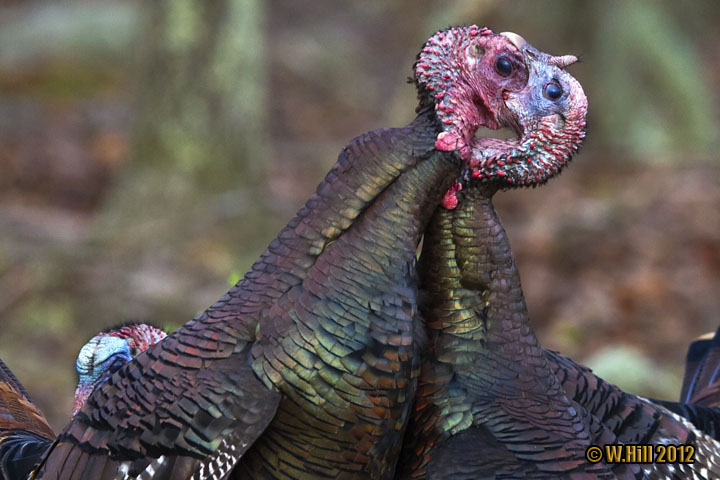
I have been spending most mornings and evenings photographing the Eastern Wild Turkey Mating season. At this point it seems that due to the early warm spell that we had in late winter and early spring, the peak of the strutting and gobbling activity has passed. In fact I have not seen a mature gobbler strutting in the past week, although I have seen jakes (immature gobblers) doing so. I see a flock of jakes each day and these are some of the most combative birds that I have encountered. If a solitary mature gobbler, or pair of gobblers get close to them, they will attack--sometimes in a flying V military type formation. Sometimes they even fall out among themselves. This happened on Thursday morning, and I  filmed and photographed  the longest gobbler fight I can recall seeing.

Jakes Fighting: Canon 40D-28-135mm EF IS ISO 400

 It all began with a lot of cackling and running about and then one jake grabbed another by the head with the tip of his beak.  I frantically got the video camera positioned and began filming until I captured several minutes of the action and then reached for the Canon 7D and the 300mm F2.8, which was on a tripod beside the video camera in the blind. (I took the above photo hand held at one point to get a still photo that established the scene).  

The heads were the main point of contact between the birds, and the area in which they grabbed each other changed from time to time.  In the photo below the one on the left has his upper beak rammed down the throat on the one on the right.

Headlock:  Canon 7D -300mm F2.8 IS L ISO 640 1/500 sec. f2.8

 For a time one bird controlled the other simply by grabbing it with the point of the beak.  This had to be a painful experience.

Controlling With Beak:  Canon 7D -300mm F2.8 IS L ISO 640 1/800 sec. f2.8

 In the photo below there are four birds.  The one in the back to the left and the one in front are looking on, while the two birds in the previous photo are still connected by the tip of the beak hold.  At times they would also enter the fray and in a few cases turkeys would leap in the air, kick their opponent and beat them with their wings.  I captured some of this on video, but got no good still photos.

 "Come On--Take Him Down!:  Canon 7D -300mm F2.8 IS L ISO 640 1/800 sec. f2.8
  
Shortly before the fight ended they walked into an area where the sunlight created a spotlight effect in the forest.  This shows how birds often entwine their necks when fighting.  It reminds one of two snakes twisted together.


 Twisted Together: Canon 7D -300mm F2.8 IS L ISO 640 1/1000 sec. f2.8

In a few more moments one of the birds decided enough was enough, broke away and left at a leisurely pace.  Soon the entire flock began moving slowly to another area and the excitement was over for the morning.

I used ISO 640 as a compromise to get a sufficiently high shutter speed to capture the action, while still having a reasonable noise level in the image.  While ISO 800 is usable with the 7D, I much prefer to stay at 400 or below--although 500 and 640 are not bad. 
Originally published at Pennsylvania Wildlife Photographer by Willard Hill.


Tuesday, April 10, 2012

Bull Elk Fight On Winslow Hill: filmed by David Anderson

I have been filming and photographing the Pennsylvania elk herd since 1995. From 1995 until 2006 my filming was done with a variety of SD (standard-definition) camcorders. This included large shoulder mount VHS and S/VHS camcorders, compact Hi-8, Digital 8, and min-DV units. The most impressive of these were the Canon L2 Hi-8 camcorder, and the Canon XL-1s mini-dv camcorder.  Both of these units accepted the full line of Canon EOS lenses and were capable of delivering professional results at long range.

Times change however, and HD (high definition) widescreen video began making serious inroads in 2005.  I bought a Sony HVR-A1u HDV camcorder in 2006, and realized that one had to go completely HD to have any hope of competing in the near future so I procured a Canon XL-h1 HD camcorder in Januray 2007.  One of the major problems was that much of the wildlife behavior I had captured on SD was hard to obtain and it was going to be very difficult to capture equivalent HD footage in a reasonable time frame.

I had captured several bull fights with the Canon L2, which were included in the film "The Truth About Pennsylvania's Elk Herd",which was released in 2008. One of these fights, which was between the famous character bull Fred ( a.k.a. Bull 36) and a large 6x6, was selected as the fight sequence for the Elk Country Visitor Center theater presentation.

I have been working since 2008 on a sequel to this film, but in all of that time I have been able to only capture short snippets of fights except in one case I did capture a fairly lengthy fight between two collared bulls, but I did not want to use this as the featured fight in a new film, as it was shot under less than ideal conditions.

Fast forward to 2011 and again I captured only a few brief encounters that really didn't qualify as fights, but this time I was in luck as fellow elk photographers and videographers, David Anderson and John Koshinski came to the rescue with dramatic fight footage.

Today we feature a short clip of about one minute in length that is taken from the new film, which will likely be known as "Pennsylvania Elk Country".


David Anderson, a talented wildlife artist and photographer from West Newton, Pennsylvania filmed this with a Canon 7D and a 300mm F4 L lens and did an excellent job of following the motion.  The fight is shortened considerably for inclusion in the film, but the most important moments are shown.  This fight is between an aggressive 5x5 and a medium-sized collared bull.

Aside from dramatic action and the fine camera work, this clip is notable because it was taken with a DSLR--something that could not have been done just a few short years ago.  It was the inclusion of the ability to record widescreen HD video on the Canon 7D that caused me to be among the first purchasers of this camera.

Look for "Pennsylvania Elk Country" to be released sometime in the third quarter of 2012, although the date of release name of the film, and content of sample clips is subject to change.

Originally published at Pennsylvania Wildlife Photographer by Willard Hill.

Friday, April 6, 2012

Eastern Wild Turkey: Gobbling Season Continues

Mature Gobbler Struts During Peak Of Mating Season: Canon 500mm F4 -ISO 100-1/1000-f4
Camera hunting differs from gun hunting in that season is never closed unless an area is restricted to bar photographers, but yet one still faces the constraints of the natural seasons.  While One can certainly photography turkeys all year around, the fact remains that springtime is the most interesting period to do so as that is when the birds are most active and the gobblers look their best as they strut and gobble during mating season.

It is quite an experience to film or photograph a mature gobbler in full courtship display, especially when they are in a very aggressive mood and gobble frequently.  Some prefer to photograph the birds in meadows, while others prefer the woods, but I like to select an area to place by blind that is at the edge of a meadow with woods to my left and meadow to the right, which gives me the opportunity to try for both types of photo if the birds co-operate.

Mature Gobbler In Woodland: Canon 300mm F2.8- ISO 400-1/320-f2.8
It is especially rewarding when one of the large birds walks extremely close to the blind and parades about.

Mature Gobbler Close Up-Note that ear is visible-Canon 500mm F4-ISO 200-1/1000-f4
Here in southcentral Pennsylvania, gobbling season is now at its' peak.  Birds will still be active when spring gobbler season comes in on the last Saturday of April, but activity will be less than it is now and it will crash on public lands that are subjected to heavy hunting pressure.  Although it is possible to hear gobblers at times throughout the year, most of the gobbling activity will be over by late May or early June.

Originally published at Pennsylvania Wildlife Photographer by Willard Hill.