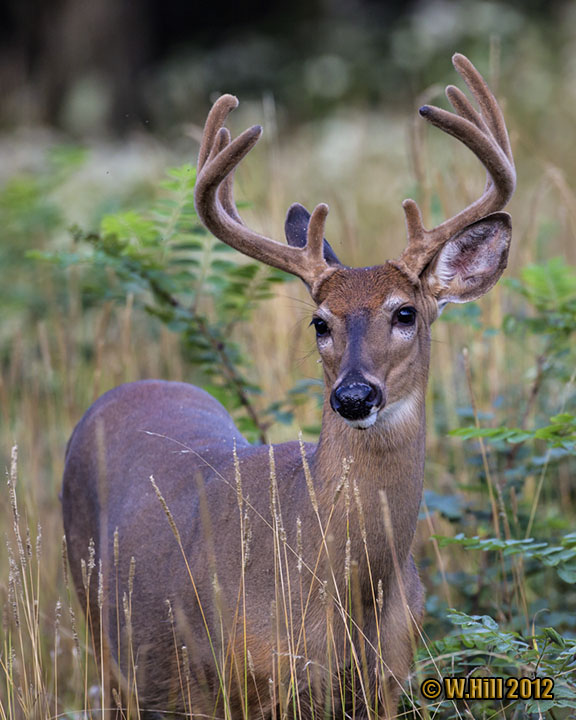
Perhaps the biggest story of 2012, for those who love to photograph
whitetail deer in the Mid-Atlantic area, was the destruction of quality
deer photography at Shenandoah National Park in Virginia, when most of
the mature bucks and many of the does at the prime visitor areas such as
Big Meadows were fitted with radio collars. Some times one can see
something bad coming a long way off and have time to mount an offensive
against it, or in the worst case scenario accept that it is about to
happen and change plans accordingly, but this happened so quickly that
there was no chance for objection before it was an accomplished fact.
 |
| Whitetail Buck Before Collaring Craze Began |
 |
| Young 8 Point Performs Lip-Curl |
Little did I realize when my brother Coy and I
encountered these bucks in velvet during an August trip to SNP, that
things were about to change drastically in the next few weeks. I will
admit that I should have seen this coming as whitetail deer have become a
controversial species during the past several years, which has resulted
in drastic moves to reduce deer populations in many areas.
Here
in Pennsylvania we fist heard of the controversy about too many deer on
National Park land when a herd reduction program was proposed and
eventually implemented at Gettysburg Military Park. The same situation
later happened at Valley Forge National Historical Park near
Philadelphia. Both programs are ongoing. I have not photographed deer
at Gettysburg or Valley Forge, but from what I have heard and read it is
no longer worthwhile to pursue this activity there.
We
first learned about the problem at SNP from Jim Borden, a wildlife
photographer from Pennsylvania, who e-mailed us a link to a post on
Flickr by Virginia wildlife photographer, Larry W. Brown. Mr. Brown
went on to publish more posts on the subject. You may find these posts
here:
Public Input Is Important
This Assessment Cannot Be Just About CWD
National Park Toys
The
upshot of the situation was that we found Larry Brown's description of
the impact on the Big Meadows herd to be extremely accurate when we
traveled there to photograph the rut in early November.
 |
| Collared Buck At SNP |
|
|
|
|
|
As one read more about the controversy, it seemed
more and more likely that the study was not just about dealing with CWD,
but that it was actually much broader in scope. This concern seems to
be validated by a
Natural Resource Fact Sheet, "White-tailed Deer Issues and Management" published by the National Park Service. The document states it was last updated on October 24, 2008.
In the post of October 25, 2012, "Shenandoah Whitetails Under
Assault" on this blog, I wrote, "They state on the facebook page (SNP's current Facebook page at the time), "this
research is being done to protect the deer herd from a horrible and
fatal disease--Chronic Wasting Disease", but they fail to point
out that there are basically only two forms of response to the
presence of CWD--either do nothing or kill as many deer as possible
in a designated containment area in hopes of eliminating all infected
animals."
It addresses CWD to a certain extent at the end of the fact sheet as quoted below:
"• In 2006, the Virginia Department of Game and Inland
Fisheries implemented Statewide chronic wasting disease
(CWD) deer movement restrictions. This effectively ended
all capture / relocation of beggar deer in the Park
developed areas.
• CWD is discovered in Slainsville, WV in free- ranging
deer. This location is less than 35 miles from Front Royal
and the Northern end of the park.
• In December 2007 a CDW positive deer is discovered in
Yellow Spring , WV. This location is less than 25 miles from
Front Royal and the Northern end of the park.
• Since 2007 the park has been in the process of developing
an Environmental Assessment Plan for CWD detection and
initial response."
This serves to partially validate
their claim that the study is about CWD, but a close perusal of the rest
of the Fact Sheet reveals that the main concern in 2008 was really
about herd reduction. Again I quote from the Fact Sheet: (Note: BMA is
Big Meadows Area, and LMA is Loft Mountain Area.)
"Park staff is currently attempting to secure funding for a
deer population dynamics study at the BMA and LMA.
This study will help us determine the cultural carrying
capacity for the BMA and LMA deer herds which in turn
will help us maintain more natural deer populations,
prevent further landscape degradation, and prevent
historical scene degradation. Ultimately, more natural deer
populations in park developed areas will help preserve the
natural landscape features (rare wildflowers, etc.) that
visitors have come to expect in places like the unique highelevation
Big Meadow. The findings of this study will
generate tangible deer management recommendations.
These recommendations along with the results from future
studies will be used to update the park’s Deer Management
Plan and to formulate an Environmental Impact
Statement. This will allow park managers to better manage
the park’s deer populations in developed areas."
So we
find that CWD is not the foremost concern at all in 2008, but it seems
that with CWD being found in more and more areas that the NPS latched on
this as a means of convincing the public of the need for a study in
SNP. (Note: As best as I can tell no CWD cases have been found closer to
SNP than had been discovered in 2008.)
Stay tuned as
we pursue this subject from time to time as more information becomes
available, Hopefully this will have only a short term impact on
whitetail photography at SNP, but I would not hold my breath waiting for
the good old days to return.
A special thanks to Jim
Borden, Larry W. Brown, Jim Fields,Todd Mann, Tom and others who shared
their insights on the situation, either through e-mails or in comments
on previous posts in the series.
Originally published at
Pennsylvania Wildlife Photographer by Willard Hill.