Sunday, January 13, 2008

Introducing Jim Moore

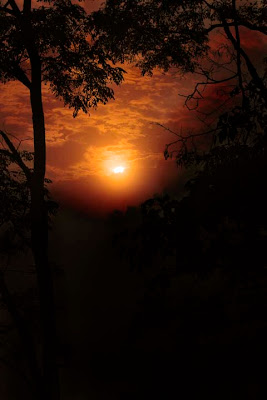
For those who requested it, here is the Black and White Version of Friday's skywatch post. This was done by a technique disclosed by Scott Kelby in "The Photoshop CS2 Book For Digital Photographers. This involves using the lighness channel rather simply converting to grayscale.


He describes several more interesting techniques, but I went with the first one.


New Blog: Excellent Commentary


I recently had occassion to exchange e-mails with Jim Moore, an excellent photographer with a very throrough knowledge of the technical aspects of photography. He is also an excellent photographer.


"Salty" of Country Captures and I were discussing Friday's skywatch post on Saturday evening and he touched on a theory which we discussed in detail.

When I checked the blog that evening, I was amazed to find that Jim had responded to a previous comment, and in doing so covered the aspect we had discussed in a very thorough and accurate fashion.

I was so impressed that I asked his permission to reprint it as a post for those that failed to see his response. He said it much better than I can!


Here is Jim's take on things:

I fully support Willard's answer on the role of artistic freedom in the photographic process.

Unfortunately, the majority of the public believes two myths:

1) That the camera alone creates the image...and that they too could produce the same image if only they had an expensive camera.

My response has always been that it's not the camera and equipment that creates beautiful photographs--it's the skill, knowledge, expertise, and experience of the person using the camera.

The bottom line is that an artist uses whatever tools they have at their disposal to exercise their creativity and express their vision. In the case of a painter, it is not the brush, pigment, or media upon which the artwork is produced that establishes and determines the aesthetic qualities of the finished painting. Rather, it is the hand of the painter who sets those tools in motion.

2) The second myth I frequently hear is posed as the question, "Are those colors real, or did you Photoshop them?"

Of course they're real; and, Yes, I use Adobe Lightroom to convert my digital RAW file into a readable image and to restore the contrast, saturation, and tonality that a digital sensor does not provide. Then, I use Adobe Photoshop to emulate the same processes and techniques routinely used in the chemical darkroom: dodging, burning, contrast masking, tonality adjustments, etc. The difference is that the digital darkroom provides much greater control of those techniques than what the chemical darkroom did. It's also a much more enjoyable environment to work in: no noxious chemicals.

The truth is that all film and all digital sensors record color, tone, contrast and saturation differently. Indeed, some films are capable of recording colors, luminosity, and tonalities that we do not see at the scene. A photographer chooses a particular film that will allow them to express their artistic vision for a specific scene. The choice is based on the characteristics of that film; i.e., color warmth or coolness, high contrast or low, high saturation or low, high speed or low, film grain or relative absence of grain upon enlargement, etc. The wonder of digital sensors and the digital darkroom is that one can apply the same characteristics of a particular film via exposure, film speed, image development (RAW conversion), and image enhancement (post-processing in Photoshop), etc. on the fly without having to change rolls of film.

What the public never realizes or acknowledges is that the *.JPG images produced by their digicams have been processed by the camera's onboard microprocessor to adjust the color, tone, luminosity, saturation, etc. in exactly the same way that is done in the digital darkroom (why do you think you have different settings such as "sports", sunrise/sunset", "landscape", "people", etc. available on your digicam?). Further, when they take their roll film to the drugstore for processing they don't realize that the development and processing in the chemical darkroom is done to a standard that produced a "pleasing" result for a test group of people. Frankly, anybody can have their film pushed or pulled during development, or developed and processed with different techniques to get different visual results.-----

The arguments and myths of the general public regarding what photography is or how it should be done are much like the Apple/PC or Canon/Nikon debates: non-starters. However, if you want to disagree with or discuss my statements above, critique or comment on my photography, learn or discuss what photography is really all about, or whatever...I would be happy to reply. Send your email to jwmoore@transient-light.com.

Be sure to visit Jim at both his blog and his website. He already has some excellent posts and photographs.

Jim's Blog
Jim's Website

Thursday, January 10, 2008

Fulton County Sunrise

While sorting through some pictures from this summer in search of suitable pictures for a DVD jacket I came upon this sunrise photo which was taken on August 26, 2007. The camera was the Canon 10-D with 70-200mm F2.8 L IS at 70mm.


I don't remember exactly how I did it, but I added the fiery color in photoshop. It was sort of drab looking before I did that. Actually it would likely make a decent black and white also.

I hope to soon continue the narrative about the elk, but there has been too much going on lately to do serious writing.


Wednesday, January 9, 2008

What's She Thinking?


Here is a shot of one of my favorite subjects. This was taken quite recently with the Canon 40D and 500mmF4 lens. This deer totally accepts me and was not alarmed at my presence.


She and her cohorts, live over a mile from the nearest highway and are not likely to cause a collision such as happened to Kerri's son over the weekend. Although deer are my favorite animal they do cause problems at times. I am glad that her son escaped the encounter without injury!

Whitetail Doe aged 1 year 7 months


Deer in this area's main concerns are avoiding predators, poachers, trespassers, and road hunters.

When I see them this close I often watch their expressions and wonder what they are thinking about.

Sunday, January 6, 2008

This Camera Changed My LIfe!

The Canon L2-A Life Changing Camera!

Canon L2 with 75-300 Canon IS: Elk County Pennsylvania


When I acquired the L2 in 1997 I was an avid squirrel, woodchuck, and turkey hunter, but my first and foremost interest was hunting the whitetail deer, whether it be with gun or camera.

A favorite activity was hunting turkeys in the fall, which coincided with the mating season of the whitetail deer or “the rut” as it is commonly known. I acquired my first SLR, a Minolta SRT 101 in 1974 and from that point on usually had a camera along. When I changed to video in late 1990, the SLRs were replaced by a VHS camcorder. I didn’t carry a tripod so that I could also have the firearm along.

This approach worked well for several years, but over a period of time I found that I enjoyed the whitetail photography and video recording more than the turkey hunting, and often wanted to kill a turkey quickly so I could put the firearm away and concentrate on the photography. Although I didn’t have inkling at the time, this compromise situation was about to change.

As I mentioned earlier, I bought a used L2 camcorder in May of 1997. That fall I bought a Canon 75-300 EF IS zoom lens on the recommendation of the same Kim Morris who introduced me to the long lenses on the Canon L cameras. This lens worked quite well and became a favorite until I replaced it with the Canon 35-350 L.


I was literally like “a kid in a candy store” with this outfit. For the first time I was able to really reach out and get video footage. Where previously one had to hide in blinds to get subjects close enough, now larger animals such as deer and elk could be photographed at extremely long range so I was able to range over the countryside in search of wildlife and still get good detailed video footage.

One drawback was that the L2 required the use of a tripod in almost all cases. In time I came to realize that this applied to all camcorders as I became very aware and intolerant of shaky footage. However, with the L2 and the powerful lenses it was even difficult in some cases to get good footage with a tripod because of vibration.

When fall arrived I realized that I had to choose between my old methods of operation or I could leave the firearm at home and pursue the wildlife with the camera. When it came to the crucial test the camera won out, at least until deer season.

I did hunt deer that year, but a new way of looking at things was surfacing almost unbeknownst to me. I videotaped a nice nine-point several times in the fall of 1996. To my surprise I saw and recorded him that summer on a farm less than a mile from where I saw him in the fall. He was definitely the same buck, but he was now a large ten-point. When rutting season arrived he moved back into the area and I recorded him on numerous occasions. One day I realized that there was no way I would shoot him with the rifle if I saw him in deer season. Even though I had not encountered him at close range and he had not bonded with me, I now viewed him through different eyes and felt a bond with him. As luck would have it I did not encounter him and so was not put to the test, but I am certain that I would have let him live.

That was one factor, but another of equal importance was that this camera caused me to spend more time afield and to see animals doing things I had never witnessed before. I began to identify with them, and changed from observing and photographing them as possible targets of a hunt, to photographing the animals and interacting with them being the entire reason for being in the field. This may not have the excitement of putting an animal down with a bullet, but to me it had a much deeper satisfaction and I felt much better about things at the end of the day. As one gets older, they require less and less excitement anyway.

The following year I only took the rifle one day on a half-hearted walk into the mountain. I hunted one morning and evening with the muzzleloader and that was it. My gun hunting was over!

Within a year this camera would inspire me to travel to Shenandoah National Park and in 2001 to Cades Cove in The Great Smoky Mountains


Young Bull Browsing In Spring: Althugh not taken with the L2, that camera was responsible for renewing my interest in still photography and I got the Minolta's back in service in 1999 and changed to Canon DSLRs in 1999.

To Be Continued: